
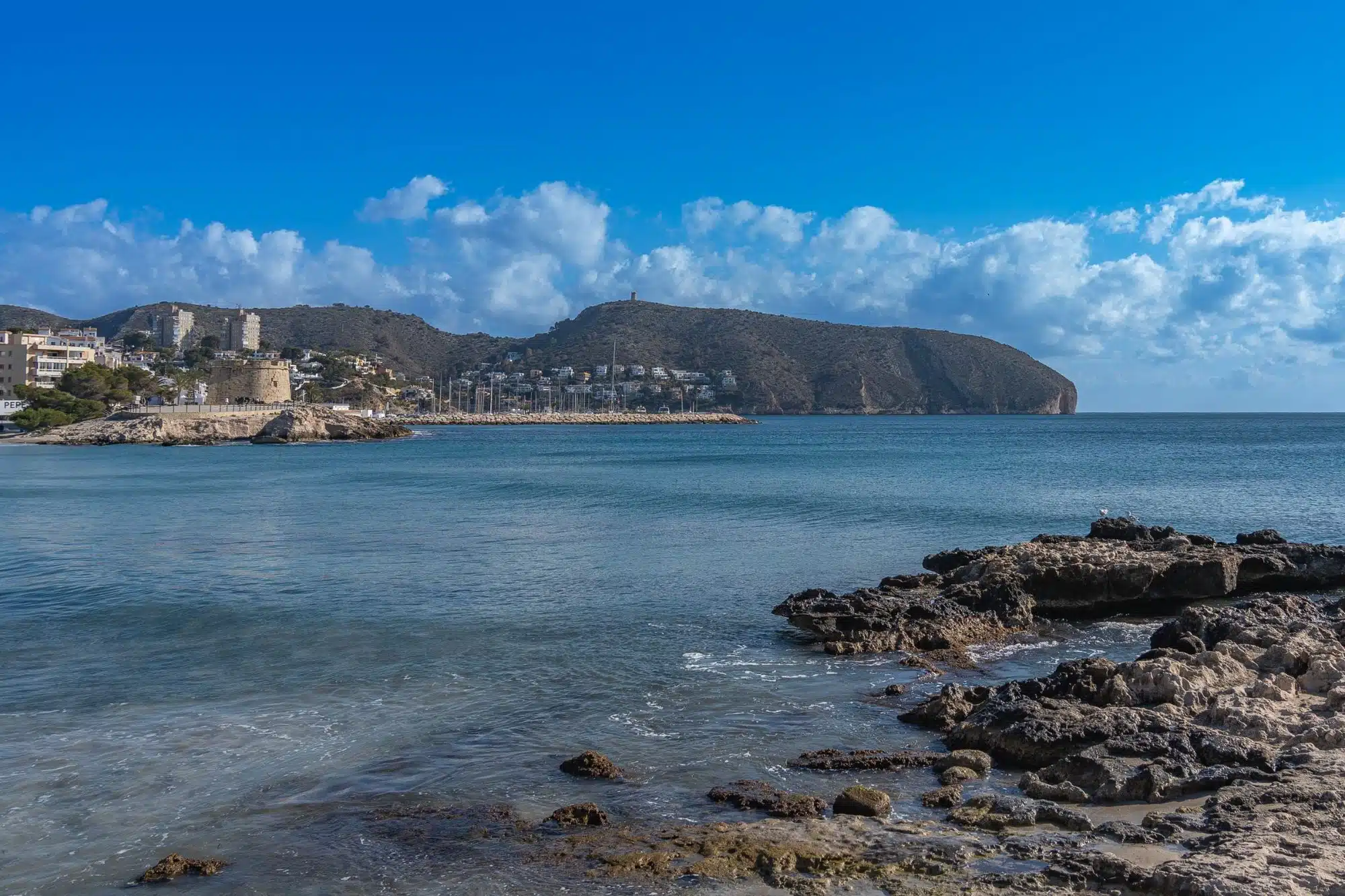
Conveyancing Lawyer in Moraira for British Buyers
Independent Spanish lawyers helping British expats buy and sell property in Moraira and Teulada for over 30 years.
Searching for a conveyancing solicitor in Moraira? Our property lawyers handle the complete legal process of buying and selling real estate in Moraira and Teulada for British expats and international clients. From contract review to Land Registry registration, we ensure your transaction is legally secure and hassle-free.
Talk to a lawyer before you pay — and if you already have, call us anyway. A small reservation deposit is often requested just to hold a property. It is always best to let us check the property and the terms before you hand over any money or sign a reservation. And if you have already paid a deposit or signed, call us now — it is not too late for us to review it and protect your position. Your first call is free.
BuyingBuying property in Moraira
- Due diligenceLand Registry searches (Registro de la Propiedad de Jávea), planning verification at the Ayuntamiento de Teulada-Moraira, debt and charge checks.
- Contract reviewReservation agreements, arras contracts, new build purchase agreements.
- NIE and bank accountTax number and Spanish banking.
- Notary completionSigning the escritura at the nearest notary (Dénia or Jávea).
- Post-completionLand Registry registration, utility transfers, IBI, community fees.
SellingSelling property in Moraira
- Sale preparationEPC, Cédula de Habitabilidad, community debt certificates.
- Contract draftingContract drafting and coordination with the buyer’s lawyer.
- PlusvalíaPlusvalía at the Ayuntamiento de Teulada-Moraira.
The townMoraira’s property areas, one by one
Every part of Teulada-Moraira raises its own questions. We know which ones to ask because we deal with them every week.
- El Portet, Cap d’Or, Fanadix, Pla del Mar, l’AmpollaFirst-line plots, where the Spanish Coastal Law and the public boundary line fixed for that stretch of coast decide what may ever be altered, extended or rebuilt.
- Benimeit, Paichi, Sabatera, Cap BlancHillside plots with sea views, where the fenced garden, the retaining walls and the pool terraces do not always match the licence or the registered plot.
- Moravit, Pinar de l’Advocat, San JaimeEstablished urbanisations, where the usual question is whether the fenced plot, the registered plot and the licensed house are the same thing.
They guided me expertly through a property purchase, showing deep knowledge of Spanish law, attention to detail, and clear communication throughout. Reliable, efficient, and trustworthy.★★★★★Lisa Damen · Google review
Due diligenceBuying in Moraira: what actually needs checking
Moraira is the coastal part of the municipality of Teulada-Moraira. That matters more than it sounds: the town hall, the planning department and the licensing records are in Teulada, and the property itself is registered at the Registro de la Propiedad de Jávea. A buyer who is told that everything is handled “in Moraira” is being told something that is not quite right, and it is usually the first sign that the person advising them does not work here.
Coastal law. Properties in El Portet, Cap d’Or, Fanadix, Pla del Mar and Playa de l’Ampolla can fall within the protection and transit easements of the Ley de Costas. This is not a formality: it restricts what can be built, extended or enclosed, and it rarely appears in the sales brochure. We check the official boundary line — the deslinde — against the plot before you commit to anything.
Municipal planning. We confirm how the plot is classified under the planning rules of Teulada-Moraira, which licences were actually granted, and whether what stands on the plot matches what was authorised. Extensions, pool houses, terraces and boundary walls added over the years are the usual source of surprises in this municipality.
And this is not done from a desk. On a villa purchase we always advise a prior inspection by an architect, in addition to our legal checks. You choose and instruct the architect directly: your own, or, if you do not have one, Sergio Tomás Arquitectos in Jávea, whose details we give you. A lawyer can read a registry entry; only an architect who knows the terrain here can tell you whether what you are buying was lawfully built.
All of this happens before the deposit contract is signed, not after. Once the arras are signed, your negotiating position is gone.
Disclaimer. The information on this page is general in nature and does not constitute legal advice. Every property and every transaction is different, and the applicable rules may change. No decision should be taken on the basis of this page alone without obtaining advice on your specific case. Tomas Ballestero Lawyers accepts no liability for actions taken in reliance on this general information.
Buying at the top of the Moraira market? See our page on luxury villa purchase in Moraira.
Registry vs realityWhat is actually built, and what the deed says
Most villas in Moraira and Teulada are not what their deeds describe. A house registered decades ago may today have a garage that became a guest flat, a terrace that was covered in, a basement that was dug out, a summer kitchen, a pool, a pergola that turned into a room. Each was a decision by a previous owner, and in many cases it was never declared, never licensed and never registered.
Three separate records describe the same house, and none of them has to agree with the others: the Land Registry in Jávea, which holds what you legally own; the Cadastre, which holds what the tax authorities have on file; and the physical reality standing on the plot. A buyer who has read only the nota simple has seen one of the three.
The gap matters in practical ways. Banks lend against what is registered, so if the valuer measures more than the registry describes, the mortgage can stall. When you come to sell, the buyer’s lawyer will find what your lawyer did not. Insurance may not cover what was never declared. And if you want to carry out work yourself, the town hall in Teulada starts from the registered and licensed position, not from what is there.
Undeclared work can often be regularised. Spanish law allows an existing building to be declared on the basis of its age, where enough time has passed that planning legality can no longer be restored. It requires a technical certificate from an architect stating what exists and since when — and it is not available everywhere. On non-developable land inland of Teulada, buildings may instead fall under the regime of fuera de ordenación, or require a procedure to minimise territorial impact under the Valencian planning law. Which of these applies is a technical question, not a guess.
This is why we advise having an architect inspect the house before you sign. He measures it, compares it against the registry description, the cadastral record and the licences held at the town hall, and his report tells us what is legal, what can be regularised, what cannot, and what the gap will cost to close. That report changes the negotiation. It has stopped clients buying a house whose guest annexe could never be legalised, and it has also been the reason a client bought with confidence when the selling agent had no answer.
The sellerWho is actually selling you the house
Before the price, before the survey, before the mortgage, one question decides whether there is a purchase at all: does the person offering to sell have the power to sell? The name on the deed is not always the answer.
The seller is a company. The signature must come from someone with authority to give it. A director’s ordinary powers do not automatically extend to selling the company’s principal asset. If the company is foreign, its powers must be proved in a form a Spanish notary will accept — normally apostilled and translated by a sworn translator. We also confirm the company exists and is in good standing.
The property belongs to several people. In a proindiviso all the co-owners must sell. One brother agreeing is not a sale. If one is abroad, or unwell, or not speaking to the others, he must grant a valid power of attorney, and that takes time. Where two of the co-owners are a divorced couple, we read what the divorce settlement actually says about the property, because what was agreed between them and what the Land Registry shows are frequently different things.
The owner has died. This is the most common one on this coast. The property is still registered in the name of a parent who died years ago and the family is selling. Nothing can be sold until the inheritance has been formally accepted and registered — the will or declaration of heirs, every heir signing, the inheritance tax settled, the property put into the heirs’ names. If the deceased was foreign, the law governing the succession has to be determined first. This is not paperwork that can be done in the week before completion.
The seller is married. Where the property is the family home, the spouse’s consent is needed even if only one of them is the registered owner. Where the couple married abroad, their matrimonial property regime — and therefore who owns what — may be governed by foreign law.
Someone is signing under a power of attorney. We read it. Is it in force? Was it granted for this? Does it allow the attorney to receive the price? Has it been revoked?
Every one of these situations comes through our office regularly and every one of them can be resolved. What cannot be resolved easily is discovering it after a deposit has been paid, when the money is in someone else’s hands and the contract you signed did not contemplate the problem.
The buyerWhose name does the property go into
Buyers tend to treat this as an administrative detail to be settled at the notary. It is not. It is one of the few decisions in a purchase that is expensive to change afterwards, and it is usually taken in a hurry at the worst possible moment.
You can buy in your own name; jointly, in which case you must also decide the shares and those shares have consequences later; as a married couple, where what each of you owns may be determined by the matrimonial property regime you married under, which for most foreign buyers is not the Spanish one; jointly with children, often done with succession in mind, which works but creates co-owners who from that moment have rights of their own; or through a company, Spanish or foreign, which can make sense in larger transactions or where the property will be let, but which brings continuing obligations and its own tax treatment.
It has to be decided before the deposit contract, because the contrato de arras names the buyer. If the buyer named there is you personally and the deed is then granted in favour of your company, your spouse or your children, the transaction no longer matches the contract. Depending on how it is handled that can mean renegotiating with the seller, redrafting, or the operation being treated as two transactions rather than one — with the consequences of two.
There is a practical point as well. Everyone who appears on the deed needs a NIE. If you decide at the last minute to add your son to the purchase and he does not have one, the signing date moves.
The right moment for this conversation is at the beginning, when you instruct a lawyer, alongside the questions about the property itself. It takes one meeting. Left until later, it takes money.
SellingSelling a villa in Moraira: get the paperwork right before it goes on the market
A villa sells faster, and at the price agreed, when its documents are in order before it is marketed: what is registered matches what is built, the licences are in place and the certificates a buyer or a notary will ask for are already to hand. When we act for a seller, that review is where we start.
The first thing is whether what stands on the plot matches what the deed and the Land Registry describe. Pools, guest annexes, covered terraces and extensions built after the original licence can often be brought into the title by a declaration of new build by age, on the basis of an architect’s certificate of the year of construction. This is a separate deed, signed before the notary and registered before the sale deed, so it needs time: it is far better done by the seller in advance than left to be sorted out at the last minute.
We then obtain from the town hall of Teulada-Moraira the certificate that no planning infringement is pending. Two other documents a sale needs are prepared by an architect, not by a lawyer: the second occupation licence or the equivalent responsible declaration, where the house does not have one, and the energy performance certificate. You instruct the architect directly, your own or, if you do not have one, Sergio Tomás Arquitectos in Jávea, whose details we give you. On first-line properties we also obtain from the Coastal Authority the certificate showing how the boundary line affects the plot, so the question is answered before it is asked.
Alongside this we gather the rest of what the sale requires: the community of owners’ certificate of debts, receipts for IBI and utilities, and the Cadastre reference matched to the Registry description. If the seller is not resident in Spain, we deal with the retention on the price and the tax filings that follow, and we can sign the whole sale by power of attorney if you are not here for completion.
Disclaimer. The information on this page is general in nature and does not constitute legal advice. Every property and every sale is different; contact us so that we can look at your case.
Frequently asked questions
Are there special planning rules in Moraira? Yes. The Teulada-Moraira municipality has specific urban planning rules (PGOU) that affect building permits, extensions, pools, and renovations. Many older properties were built under different regulations. Our due diligence includes a thorough check of planning compliance and any required certificates.
What is the deposit when buying in Moraira? The standard deposit in an arras contract is a percentage of the price. This is paid when the private contract is signed. If the buyer withdraws, they forfeit the deposit. If the seller withdraws, they must return double the deposit amount.
Can I get a mortgage to buy in Moraira? Yes. Spanish banks offer mortgages to non-residents, typically lending up to a portion of the property value (whichever is lower). We can recommend trusted mortgage brokers who specialise in expat lending on the Costa Blanca.
For comprehensive legal assistance, explore our full range of conveyancing lawyers in Costa Blanca services. Our English and French-speaking team supports international clients across Jávea, Moraira, Dénia and the wider Costa Blanca region.
We act for buyers in the neighbouring towns as well. If your purchase is in Benitachell, see our page for conveyancing solicitors in Benitachell.
NearbyOur legal services across the Costa Blanca
- Conveyancing Lawyer in Jávea
- Conveyancing Lawyer in Dénia
- Conveyancing Lawyer in Altea
- Conveyancing Lawyer in Benissa
- Conveyancing Lawyer in Teulada
- Property Lawyer in Moraira
- Inheritance Lawyer in Moraira
- Power of Attorney in Moraira
- Achat Immobilier à Moraira (Français)
- Woning Kopen in Moraira (Nederlands)
With a power of attorney we complete every step on your behalf, from the first check to signature at the notary, remotely and safely.
Call +34 607 320 768The lawyers who will handle your purchase

Conveyancing, Inheritance and Donations · Admitted to the Valencia Bar in 1992 (no. 6407) · Alicante Bar no. 9382

Marital and Family Law · Valencia Bar no. 12075

Civil Law · Valencia Bar no. 6041

Inheritance, Conveyancing and Contract Law · Valencia Bar no. 7773

Conveyancing, Inheritance and Matrimonial Law · Alicante Bar no. 3607

Civil and Insurance

Inheritance, Conveyancing and Civil Law – Dénia · Alicante Bar no. 3699

Inheritance, Conveyancing and Civil Law – Dénia · Alicante Bar no. 3374
Disclaimer. The information on this page is general in nature and does not constitute legal advice. Every property and every transaction is different, and the applicable rules may change. No decision should be taken on the basis of this page alone without obtaining advice on your specific case. Tomas Ballestero Lawyers accepts no liability for actions taken in reliance on this general information.
Ready to talk about a property in Moraira?
Tell us which property you have in mind. We reply within 24 hours.
Talk to us about your purchaseor call +34 607 320 768